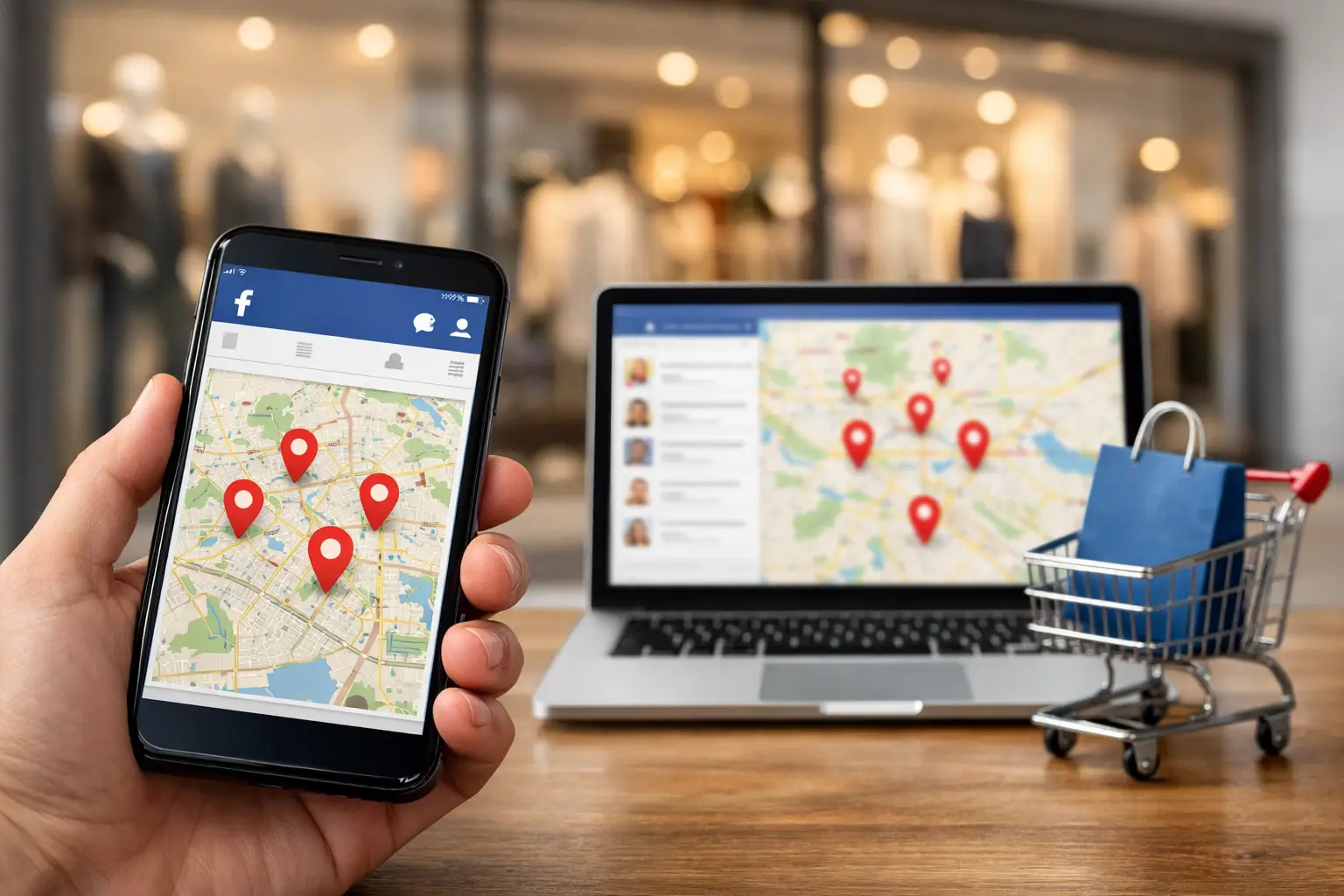
A customer lands on your Facebook page, sees your latest promotion, and decides to visit. Then the friction starts. They have to leave Facebook, search your website, scroll through location pages, and hope they pick the right store. That gap is exactly where a facebook store locator app earns its value.
For multi-location brands, Facebook is often a discovery channel, not just a social channel. People check business pages for hours, phone numbers, reviews, and nearby locations before they commit to an in-person visit. If location search is missing or clumsy, interest drops fast. A locator app gives that customer a direct path from intent to store visit, which is what matters most.
Why a facebook store locator app matters
A lot of businesses treat store locators as website utilities and ignore Facebook altogether. That creates a mismatch with customer behavior. Many users never start on your homepage. They start on social, especially when responding to local promotions, seasonal campaigns, or brand searches tied to mobile browsing.
A facebook store locator app helps close that gap by putting location search where customer intent already exists. Instead of asking people to take extra steps, you let them search nearby stores, dealers, branches, or service points within the Facebook experience. Fewer clicks usually means more completed searches. More completed searches usually means more store visits, calls, and appointments.
This is especially useful for brands with dozens or hundreds of locations. A static address list is not enough when customers need the nearest site, a specific service category, or local availability. Locator functionality turns Facebook from a passive brand page into an active conversion point.
What businesses should expect from a facebook store locator app
Not every app labeled as a locator is built for operational use. Some are little more than maps with pins. That may work for a small business with one or two locations, but it breaks down quickly for franchises, dealer networks, banks, hospitality groups, and retailers with more complex location structures.
At a minimum, the app should support accurate location search, mobile responsiveness, and easy updates. If your address data changes often, manual edits inside multiple platforms will create delays and errors. The best approach is a centralized locator system that feeds consistent location data wherever customers search.
Search quality matters just as much as presentation. Customers should be able to search by city, state, ZIP code, or proximity. If your business serves different customer needs across locations, category filtering becomes essential. A restaurant group may need separate results for dine-in, drive-thru, and catering. A bank may need filters for ATMs, branches, mortgage services, or investment offices. A dealer network may require product line or territory-specific searches.
Hours, phone numbers, directions, and store details also need to be current. If a customer finds the wrong closing time on Facebook, the issue is not just inconvenience. It affects trust in the brand.
The real business value is conversion efficiency
The strongest case for adding locator functionality to Facebook is not that it looks polished. It is that it reduces drop-off between digital engagement and offline action.
A user who visits your Facebook page is already signaling interest. They may have clicked from an ad, a local search result, or a recommendation. That is high-intent traffic. If they can immediately find the nearest location, the path to conversion is short. If they have to hunt for location information, that momentum weakens.
For marketing teams, this matters because social performance is not only about impressions or engagement. It is also about whether campaigns help real customers reach real locations. For operations teams and franchise groups, it matters because every preventable obstacle can reduce local foot traffic.
This is why a locator should be viewed as conversion infrastructure. It supports convenience, but it also supports measurable business outcomes.
Features that separate a useful app from a basic one
Mobile-first location search
Most Facebook traffic arrives from mobile devices. If the locator is slow, cramped, or difficult to interact with on a phone, users will leave. A facebook store locator app should load quickly, adapt to smaller screens, and make search fields, filters, and result cards easy to use without zooming or extra taps.
Flexible search and filtering
Simple proximity search is a baseline feature. Better locator tools also handle product categories, service types, dealer tiers, and nested classifications. That matters for brands with layered location networks or varied offerings across regions.
Reliable hosted performance
A locator app is often most valuable during high-traffic periods tied to promotions, holidays, product launches, or seasonal demand. If uptime is inconsistent, your location experience becomes a liability. Reliability should be part of evaluation, not an afterthought.
Easy deployment and updates
Marketing teams should not need a custom development cycle every time they want to publish or revise location search. The right solution should be easy to deploy, easy to maintain, and simple to update from one central source.
Analytics that show customer behavior
A locator is not just a convenience tool. It is a source of intent data. Search activity, selected locations, and filter usage can show what customers are looking for and where demand is concentrated. That visibility helps businesses improve campaigns, staffing, and location content.
Common mistakes when evaluating locator options
One common mistake is choosing based only on appearance. A nice map interface may look modern, but if the underlying search logic is weak or difficult to maintain, the long-term value is limited.
Another mistake is treating Facebook as a standalone environment. In practice, your locator should work as part of a broader location strategy across your website, CMS, landing pages, and mobile experience. If every platform uses separate data or separate workflows, inconsistencies are almost guaranteed.
Some businesses also underestimate international requirements. If your brand operates across countries, postal code handling and regional search behavior can vary significantly. A locator that works well for a domestic rollout may struggle once international coverage is needed.
And then there is scale. A solution that feels easy with 10 locations can become cumbersome with 500. Buyers should think beyond current needs and consider how the app will perform as the business grows, reorganizes territories, or expands service categories.
How to choose the right facebook store locator app
Start with the customer journey, not the feature checklist. Ask what someone is trying to do when they arrive on your Facebook page. Are they looking for the nearest store, checking branch hours, finding a product-specific dealer, or confirming whether a service is available nearby? The right app should support those actions with minimal friction.
Next, evaluate operational fit. Can your team update data without depending on developers? Can you manage large location sets efficiently? Can the same locator infrastructure support your website and other channels as well? Those questions matter because the cost of maintaining location accuracy often exceeds the cost of initial setup.
You should also look closely at responsiveness and uptime. A locator is a practical tool, so reliability has direct commercial impact. If performance is inconsistent, customer confidence drops and campaign efficiency suffers.
Finally, look for measurable value. A strong platform should help you do more than display addresses. It should support engagement, improve convenience, and make it easier to turn social traffic into in-store visits. That is the standard that matters.
For brands managing multi-location growth, this is where a specialized platform such as Xtreme Locator makes sense. The advantage is not only that it can be embedded across digital channels. It is that the system is built around centralized management, flexible search, mobile usability, and dependable hosted delivery, which are the factors that determine whether customers actually complete a location search.
When Facebook locator functionality is most valuable
Some businesses will see immediate value from a locator app, while others may rely more heavily on web-based search. It depends on how customers discover locations and how much local intent exists on social.
If your business runs local campaigns, promotes events, manages franchise or dealer networks, or serves customers who frequently check social profiles before visiting, the case is strong. A locator app also becomes more valuable when locations differ by services, inventory, or hours, because customers need more than a simple corporate address page.
If your Facebook presence is minimal and most discovery happens elsewhere, adding locator functionality may be less urgent. Even then, it can still serve as a low-friction conversion path for customers who prefer social-first interactions.
The practical question is simple: when customers visit your Facebook page ready to act, can they find the right location quickly? If the answer is no, that friction is costing you more than it seems.
The best digital tools are not the ones customers notice most. They are the ones that remove one more reason to hesitate. A well-executed locator does exactly that, and on Facebook, that can be the difference between interest and arrival.